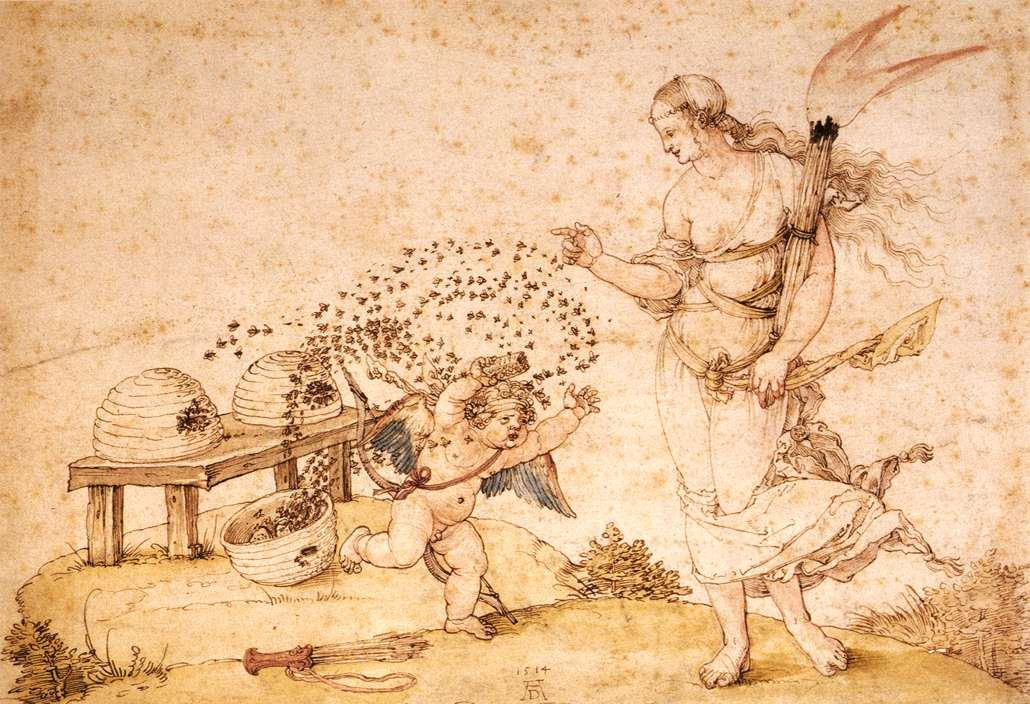
Albrecht Dürer– Cupid the Honey Thief (1514)
Ivan was right. The rain has not lasted. But here along the southern edge of Lake Wabamun, the suffocating sky remains low above us. As though it truly is falling. As though this is the way that the life of centuries was pressed into the coal which runs in rich veins through this land. Among the low hills, the sprouting crops, the stands of poplar and pine, we pass the looming Sundance Power Plant and pull into a yard hidden from the road by spruce and willow. Our engine shudders into silence, but the soothing stillness is only a momentary cue to busy it back up with our labour. I crack open my door of the truck and squint against the wind. It rushes and sucks in my ears, the boughs of sheltering trees tossing like crashing waves. Neither will the bees be fond of this weather; this is what we are thinking. But without disrupting our resolve, the two of us prepare. First, I tie up my boots, and make sure that the elastic cuffs of my coveralls are tight at my wrists and ankles. Next I pull out a chunk of burlap cut from an old potato-sack and light it on fire. With the help of my hive tool, I flip the smoldering fibre back and forth on the truck’s flatbed, allowing the wind to whip it into a healthy rage; I stuff it into my smoker, close the lid, and give the bellows a prescriptive squeeze. Finally, with ritualistic deliberation, ensuring that the cord is tied tight across my chest, I secure my veil.
Today we are checking the new queens in all these hives: also in yards further west through Keephills, south near Calmar and Thorsby, north across the Yellowhead towards Onoway. These queens have been imported all the way from Australia, and by the fate of unknown factors, compounded over their journey, they have brought with them nothing but problems.
Ivan, however, has grief of his own. Recently immigrated from Russia with his family, he is a mechanical engineer. Now in his late forties, he has decided to take advantage of his years of bee experience, rather than begin the long process of qualifying as a professional engineer in Canada. He is a stout man, thick, with a noble belly. His eyes are soft, generous, sad. Making fun of what he has learned of English through our Aussie co-worker, Ivan will ask, in his thick Russian accent, “Dave– when the fuck is fucking lunchtime?” Or, with a twinkling smirk, he will assert agreement in exaggerated, drawling mimic of Australian phonetics– “ehOw Kiay!” Knowing that I am a university student, Ivan has chosen me to attempt conversations about philosophy and literature: Dostoevsky; Buddhism; Hemmingway. He also approaches me with his many questions about our language.
“What is difference– ‘to give in— and, ‘to give up?”
This summer, here in north-central Alberta, I have worked with beekeepers from all over the world. Luis came on an agricultural exchange from Mexico; Pete is a recent ‘refugee’ from Newfoundland. Dave is from Australia, where ugly divorce forced him to break up his own independent bee business and seek a season of escape in Canada. Reese is a young guy from New Zealand, where his family has kept bees for generations– ever since his great aunt started hives at the turn of the last century.
Often, I feel my favourite part of any work is the incidental conversation.
The talking, and the listening.
The varied voices, accents, rhythms of others.
Earlier today, while driving together to our first beeyard, Ivan broke our usual morning silence by sharing with me some numbing news he just received from back home. A best friend of his, a doctor, had been working in the Black Sea town of Sevastapol, and was driving with his wife and daughter back to Moscow. He had driven this road a thousand times. This time, however, it is assumed that he fell asleep at the wheel. The friend was killed instantly, his wife and daughter left badly injured, though stable, in hospital. Ivan also knows that road. He began to tell with animated rhythm about a job he once had– buying used cars in Holland and Germany, and then driving them back to Russia to sell. Because of the danger of highway bandits through most of eastern Europe, especially in Poland, it was more hazardous to nap by the roadside than it was to keep moving. So he always drove straight through, a trip of perhaps seventy-two hours without sleep. Ivan’s story then returned to how he knew that this message was going to be terrible news. How he pretended to ignore it. Eventually, he said, he mustered the will to return the call. Driving east along secondary highway 627, through the historic ‘Hills of Hope’, Ivan’s mellifluous voice began to tremble.
I look over to Ivan, who now has begun meditatively to check frames in his first hive. I flip off the heavy lid from one close by, and I feel on my hands the sentient warmth inside. The tops of the frames are teeming with bees, which seem both aggressive and noisy. Neither are good signs. Before I can react, I am stung near the fingernail of my right thumb.
A hive that is queenless buzzes at a higher pitch than normal. Its vibration is frenzied. Chaotic. Desperate.
I give them a little smoke and wait a moment for the bees to retreat inside. Nine frames hang parallel in each hive box, which generally are stacked two high. Using my hive tool, I gently pry a top frame loose from the thick wax and the propolis that the worker bees have applied to secure it. Delicately, I pull it from the centre, where the brood is also likely centred. Although the frame is crawling with bees, they are not the subject of my scrutiny. Both sides of each frame are covered with flat comb; some of its cells contain honey, some pollen, and some bees and brood. Carefully angling the frame so that light is cast deep into its cells, I look for evidence of a healthy queen, by confirming the different stages of bee development among the cells of brood: thick white larvae, minute eggs floating in royal jelly, and capped cells from which new bees will soon emerge. Suddenly, despite all versions of anticipation, I curse in anguish. I’ve been stung three more times, on three separate areas of my hand, simultaneously.
How can you work with bees? How can you work without gloves? I often am asked.
For a few days we worked with someone who had black belts in two martial arts, and who loved to collect guns. But the guy had to quit because he was scared of bees. A group of roofers told me one day, while I was scraping frames among a few bees, that they thought I was ‘either stupid or crazy’. But what is the difference between a few stings and a few blisters? How can those guys work all day punching a nail-gun on a truss that’s thirty feet up?
A honey bee’s stinger is barbed, which is why it sticks in the skin when the bee pulls away. Although this kills the bee, the tiny poison sac at the exposed end of the stinger still throbs, continuing to pump poison into the wound until the stinger is scraped away. Indeed, that first moment of a sting always causes pain. After a month or so, however, beekeepers will develop some measure of immunity to stinging, which means that the stings one suffers are no longer accompanied by the most painful longer-term symptoms, like swelling, aching, itching, fever. Quite simply, I learned about the bees from a group of guys who never wore gloves; in fact, neither Ivan nor my boss wear even coveralls.
Swarming occurs when a hive becomes overpopulated: half the colony stays behind, and half flies off to find a new site. Led by the old queen, the departure is timed by the anticipated ‘metamorphosis’ of a number of new queens, one of whom will assert dominion over the old hive. The relocating bees first gorge themselves on honey and then fly to a nearby spot. They simply hang there together, in a large, undisturbed clump, waiting while a few scouts search as far as miles around for an ideal spot. Because its bees are stuffed on honey, loyal to their queen, and without a hive to protect, a swarm is remarkably unthreatening, sedate and quite easy to catch. By smoothly jerking the cluster over an empty hive box, the swarm will drop in like a harmless glob. As long as the queen has fallen in with the rest of the clump, the bees will remain in this box and make it their new hive.
During a particularly hot afternoon, Ivan and I discovered a huge swarm as we entered a yard close to the North Saskatchewan River. The swarm was clinging to a tree’s bough at a height well above our heads. We agreed to drive our truck under the branch, drawing us high enough to snap the swarm into a hive box. Ivan insisted on holding up the box, while I was responsible for yanking the branch. What we didn’t notice, however, was that the bough, heavy with the remarkable mass of the bees, had already cracked, losing all its flexibility. When I tried to snap it, the branch simply broke. Instead of falling cleanly inside our upstretched box, the swarm dropped all over Ivan’s bare arms. Engulfed in a vibrating field of agitated bees, we could only look to each other in mutual horror. “So many stings,” he whispered. “So many stings.”
A hive of honey bees is almost entirely female; the queen and the workers, which are sterile, are female. Only the drones, about two percent of the population, are male.
The average lifespan of a worker bee is four to five weeks; of a drone, ten to twelve weeks.
The average lifespan of a queen bee is three to four years.
A new queen will always improve a hive’s productivity and temperament. The workers will raise a new queen if the hive has become too large and is about to split and swarm, or if the ‘reigning’ queen, due to age, handicap or death, is no longer properly able to lay eggs and maintain the colony. Yet, whether introduced to the hive artificially or reared by the hive’s workers, a new queen must mate before she can properly lay. Unfertilized eggs become drones, whose only function is to mate with a virgin queen; they do nothing else, unable to perform any of the myriad tasks for which the workers are responsible in the functioning of the hive– unable even to sting. After mating, a drone immediately dies. In the fall, if the drones have not been required for mating, the workers will evict or kill them all.
When a colony possesses a number of virgin queens, the first to emerge will challenge her rivals by ‘piping’. This is a shrill “zeeeep! zeeep! zeep!” sound, which she produces by the vibration of small plates at her wing bases. By pressing her thorax against a surface of comb, which acts as a sounding board, she is able to project her call at surprising volume. A queen’s stinger is not barbed, which means that she can sting repeatedly and not die. She will never sting a human, however, leaving the hive’s protection to her workers. Initiated by piping as a call to arms, the young virgin uses her sting only against rival queens.
Remarkably, the queen mates only once in her life. On a day that must be warm enough for the bees to fly, the queen leaves the hive accompanied by a number of eager drones, who may each take a turn mating with her ‘on the wing’, or during flight. This is the only time in the queen’s life, unless she ever needs lead her overpopulated hive to swarm, that she will ever leave her hive. On this single mating flight, she receives and bears enough sperm to fertilize and lay as many as two thousand eggs a day for the rest of her life.
From across the bee yard, Ivan calls to me. “What should I say– ‘bye’, or, ‘bye-bye’?”
The only other job I ever had in the bush was treeplanting. Although the labour was quite different from keeping bees, the time working away from the city made obvious some similar conclusions. Planting north and west of High Level, in a clear-cut at the end of a frontier logging road, the mosquitoes would envelop in a shrouding cloud any mammalian host, their presence thick like muskeg. Before long, I could imagine their insubstantial bodies and pitifully single-celled brains interconnecting as a collective network; less a consciousness than a frequency; not a will, but a high pitched vibration, furious in authority, even more overwhelming to include the black flies, the horse flies, the deer flies, the no-see-ums, the wasps. Retreating into my greenhousing tent during a hot afternoon off, the collision of insects into its dome sounded as repetitive and rhythmic as rain.
Out here, the bugs are the ones in control.
One afternoon I was planting in a block west off the Alaskan Highway, north of Fort Nelson. With my metrical footfall punctuated by the cleave of my spade, I was following a winding wind-row, leaving a new path of tender seedlings behind me. Frantically, a rotund bumble bee began to circle me, alighting clumsily on my shovel hand. I paused, taking a moment to resist the impulse to shoo it off. For a few moments, I watched it sitting there, both of us still, me feeling its subtle weight upon my skin. Suddenly, dawning like an erotic epiphany, I became aware of a most remarkable sensation. I don’t know if she found salt; I don’t know if she found sweet. But for some reason, this small fuzzy creature had slowly stuck out her long, tubular tongue and– ever so delicately– was licking me.
At that point in my life, I still had never been stung.
Some years later, after splitting up with my girlfriend, I visited India alone. I was standing in a sweet shop in the town of Dharamsala, looking into the display case, which was full not just of exotic Indian sweets, but also of bees. I felt a sudden pinch, and looked down to find a tiny stinger in my arm.
The smell of this smoke from my smoker always reminds me of India.
The next morning, Ivan and I move to the next bee yard. Overnight, the dark clouds have broken up. Urged by the westerly wind, they float through the cerulean sky like thoughts.
Ivan discovers a hive overflowing with bees, perhaps only one warm day away from swarming. Despite being early in the season, they already have begun producing an excess of honey from dandelions, built up in thick comb even at the top edge of the hive’s frames. Ivan scrapes a chunk off with his hive tool and offers it to me, claiming that the wax, traced with propolis and pollen, is excellent for the gums. I slip it under my veil and into my mouth. The dandelion honey, still warm from the hive and the sun, squirts with my bite from the cells into my mouth. As I chew the leftover ball of gummy wax, softly squeaking over my teeth, Ivan calls over to me.
“What do you call the drops of water on grass in the morning?”
According to the cosmology of northern India, whose language shares the same linguistic heritage as English and Russian, the universe became manifest first as a divine vibration. The pulse of the primordial syllable ‘OM’ gave birth to all creation, and contains within it all possible sound. As the first letter of the Sanskrit alphabet, it is the one from which all the other letters are born, allowing its divine potency to manifest both through the meaning, and even through the gross sound of our common speech.
The Greeks called bees ‘the Birds of the Muses’, believing that if they touched an infant’s lips, the child would grow up with the gift of song or eloquence.
“What are the drops called if frozen?”
In the next yard, we find another swarm. But this time, after catching it easily, Ivan slips on a tight leather glove and gently scoops up an overflowing handful of the bees. Beckoning, he gestures at me to hold out my hand. I am tentative. Yet somehow– I trust him. Softly, looking into my eyes to reassure me, Ivan pours the living glob into my bare palm.
My hand is shimmering like a mirage.
 THE REVOLOCUTIONARY PATHETIC MOVEMENT